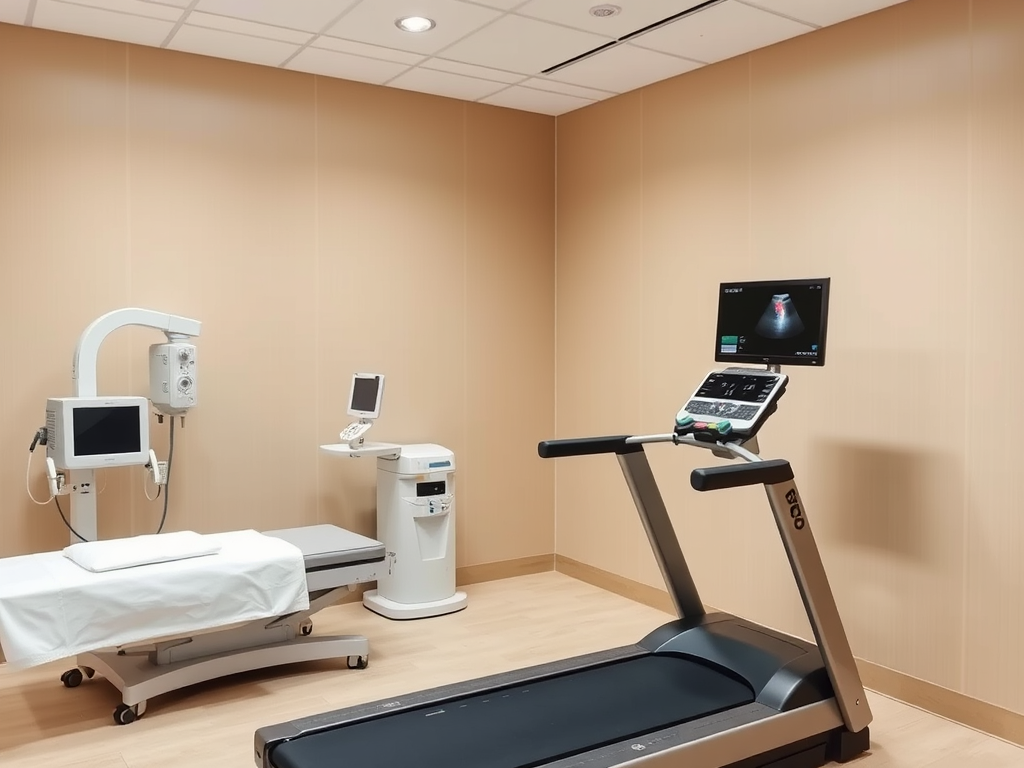
If I’m going to put myself through treatment, I might as well make it worthwhile. I decided early on that if my experience can help someone else in the future, then I’ll gladly contribute. So, I volunteered as a test subject, agreeing to follow a prescribed workout regimen throughout treatment and undergo periodic physiological testing for a cardiovascular research study.
Baseline Visit 1 began with something I’ve always wanted to do… a maximal heart-rate test. Of course, first came the preliminaries. A baseline echocardiogram confirmed I was clear to participate, followed by a general physical and neurological exam. Everything checked out. I was good to go.
“Alright,” the researcher said, “we’re going to place this mask over your face. You will bite down on the mouthpiece and make sure it seals over your gums. Your nose will be clipped so all breathing comes through the mouth. There is a drain piece for saliva, make sure you don’t swallow it. We’ll monitor your pulse oxygen and blood pressure throughout.”
Then came the instructions.
The treadmill would speed up until I reached my age-calculated maximal heart rate. Once there, speed would stay constant but the incline would be increased by about 2.5% every few minutes. I’d need to point to a chart to indicate how hard I felt I was working. Thumbs up if you’re good, Thumbs down if you’re not and open hand swiped by throat to indicate Stop.
Perfect, I thought. “Two Thumbs-up Let’s do this!”
The mask slid over my head, the tube connected to the machine at the right of the treadmill. I centered myself on the machine and matched the belt stride for stride.
“We’re almost at your calculated rate. How hard are you working?” they asked.
I pointed to – Very Light.
“Pulse ox?” The researcher asked the intern positioned to the left of me at the treadmill.
“98%,” she reported.
“Great. Beginning the test in 5…4…3…2…1.”
The incline rose. I kept a steady rhythm, hearing the doctor murmur with curiosity in the background as he observed the computer monitor. Five people were in the room: a doctor, a clinician, two researchers, one intern. With the treadmill facing a plain beige wall. Everyone behind me. So that’s what I focused on – the beige canvas.
After the first minute: “How hard are you working?” The researcher asked me.
I pointed to “Light” on the laminated chart presented to me by the intern.
Blood pressure was yelled out – 144/78.
“We’ll increase again. How are you doing?”
Thumbs up. Still feeling good.
Round after round, the incline inched upward. My arms began to pump, my breathing deepened, but I still felt strong. “I could keep this pace for six hours,” I thought.
“Pulse ox?” The researcher asked
“97%” replied the intern.
Eventually, the sweat came. My heart thudded against my ribs. My face flushed behind the mask as I gulped air through the tube.
“Keep going… every second counts… Can you give me more time?” the researcher asked.
Thumbs up. I wasn’t anywhere near passing out.
“How hard are you working?”
I pointed to “Very Hard” this time.
Another incline.
I heard the doctor gasp in the background.
The clinician whispered, “Wow, that’s amazing.”
“Pulse ox?”
“It’s reading 91%!”concern flickered in the intern’s voice.
The clinician moved toward the echocardiogram machine, positioned to the far right of the room, preparing for the moment I stepped off. My vision began to vignette….darkness creeping inward. The beige wall shifting toward gray.
“The segment is almost over. Can you keep pushing?”
Thumbs up again. If I wasn’t completely out, I could keep going. I thought.
Now drenched, heart hammering, lungs burning…. but still moving.
“Keep going… keep going.. every second counts” The researcher cheered.
I held on until the end of the segment. Then the treadmill stopped.
I stepped off the belt, grabbed the handrails, and the second researcher quickly removed the mask. They all guided me back to the exam bed for the final echocardiogram. I lay still, eyes closed, letting my senses return to normal. As the clinician quickly removed the velcro straps on the black cotton shirt exposing and my left chest wall to press down with the transducer beneath my left breast. I could still feel my heart beating.
“So… how did I do?” I asked, while she observed the monitor.
“You did amazing,” the clinician said. “Your heart rate was up there.”
“What about my VO₂ max reading?”
The clinician looked at the researcher. “Can she know it?”
“No,” they said. “We’ll share results at the end of the study.”
“Well… does it match my watch? I have a reading of 40.”
She smiled. “Close. Pretty close.”
The final echo looked good. The test was over.
And me?
I felt electric….flooded with energy.
I was asked to change into my regular attire and walk out of the room. I couldn’t help but try to take a peek at the reading glancing at the treadmill monitor and could have sworn I saw a VO2 reading of 36.
I’ll find out the true value in several months.
 Journaling was Recommended
Leave a comment